I know we are probably few and far between-but I know we are out there. I think every Kinder teacher has some GT or at least academically advanced kiddos in their classes that need to be catered to differently.
Gifted identification processes are different everywhere. We test 4-year olds with an oral administration of a spatial reasoning test and the WIATT. If they qualify, they can be placed in a stand-alone GT Kinder class (well, that is if we can recruit enough kiddos, this year my class was about 1/2 GT). Many people have raised concerns at identifying them at such a young age and to be honest, it's not always accurate. Some kids are GT and don't qualify (although they can reapply the next year with standardized test scores) and some qualify that turn out not to actually be GT.
However, I think the benefits far outweight the potential pitfalls. A student can be challenged right out of the gate. No sitting through classes where they are coloring a picture of the letter "A" when they can already read 30 wpm fluently. No having to simply learn how to count to 10 when they can add 10+10 in their heads. Nothing like creating 5-year old school burnouts! :) They also can have that foundation set for thinking skills that they might have an innate ability for, but haven't yet learned how to apply.
So, my strategies for working for young GT kiddos:
1) Be patient, be very, very patient. I can't even articulate how frustrating our first compare and contrast lesson is. What's different about these two concepts--"they are different". Yes, but how are they different. "I don't know". Ok, what's the same about them. "They are different". (Do I have to tell you how many bottles of hair dye I go through each year because of all the extra gray hair they give me :). Don't give up. They will get it, they just need a lot of practice.
2) Be flexible with your grouping. This is a no-brainer when working with any group of kiddos, but you would not believe how quickly these kids can grow. I will never forget the student-I'll call her Alexa-I was doing assessments the 1st week of school and she couldn't identify any letters-not even the "A" that began and ended her name. Fast forward to 3 months later and she was reading, writing things like "the lake glistened" (in phonetic spelling and that was a vocab word, but still!). When I pull kids to work with me in small groups they can change groups from week to week-nothing is set in stone in my class.
3) Don't push too hard. I am all for high expectations. I have written about it before-I use my regular vocabulary, not talking to them like babies. I read to them above their grade level. But when it comes to academic expectations-(and now the expectations are more stringent than ever)-I really try not to make a big deal out of Johnny not being able to read his sight words or Mary not being able to add. They are so, so sensitive and see those differences come up quickly, I don't want to add to those feelings.
4) Let your parents know how they can help their kiddos at home. Give them examples of the activities you are doing in class, websites where they can find similar ideas. Sometimes parents don't even realize they need to be challenged at home as well. It really surprises me how many kids-these kids with wonderful imaginations and outstanding critical thinking skills spend a good portion of their time watching cartoons and playing video games.
5) You have to teach them practical emotional responses. How many times I will hear a blood-curdling cry thinking Mary broke her arm only to find out Jessica wouldn't let her play the game with her. That's it, that's the big trauma. They are super-emotional and super-sensitive. Just giving them some tools in using words to express themselves can go a long way.
6) Depth not breadth. I was helping interview for a new Kinder teacher and she was going on and on about how she challenged her kids by teaching them multiplication. While I think you can teach kids to memorize the multiplication tables (they can memorize just about anything) I don't believe those students really had any real understanding of the processes of what multiplying meant. It's much more important to work on number sense and have the student do a lot of mental math to work up to a more complicated process like multiplying. Same goes for reading a student may read at 100 wpm but not be able to answer a single question or understand what he's read. That commercial for "My Baby Can Read" frightens me when the little 3-year old is showing off how she can read Charlotte's Web and the how the father is wielding the axe! Just because they can read the words, doesn't mean they should be reading those words.Many times they haven't developed the vocabulary to comprehend advanced texts.
I know in this test-driven world of education that we work in, it's easy to kind of set these kids aside--they'll do well on the test, I have to help the ones who are struggling. Or worse, you have these kids teaching the ones who are struggling and calling that their differentiation! :( But with just a few extra steps you can help set these kids off on an academic journey that can really help them develop a passion for learning.

Tuesday, June 12, 2012


Friday, June 8, 2012
My Classroom Philosophy
I think summer is a great time to sit back and reflect on what has been going right and what has been going wrong in past classes. I've been doing a lot of that reflecting myself, especially because I felt a little challenged this year. I've been seeing a lot of posters on Pinterest people put up in their rooms stating not rules, but kind of an overview of what to expect in that classroom. Or Dear Students this year you will.....I wanted to make one for my classroom as well. Not just for parents, students, etc. but so I can visualize it in my head and refer back to it when it feels like I'm going off-track:
In this class....
We create.
We think.
We take risks.
We earn praise.
We show learning in different ways.
We move.
We sing.
We explore.
We imagine.
We perform.
We paint.
We write.
We question.
We love words.
We help each other.
We debate.
We analyze poetry.
We listen to stories.
We tell stories.
We share.
We value learning.
We make mistakes.
We work together.
We laugh.
We rise to the challenge.
What would your poster look like?
In this class....
We create.
We think.
We take risks.
We earn praise.
We show learning in different ways.
We move.
We sing.
We explore.
We imagine.
We perform.
We paint.
We write.
We question.
We love words.
We help each other.
We debate.
We analyze poetry.
We listen to stories.
We tell stories.
We share.
We value learning.
We make mistakes.
We work together.
We laugh.
We rise to the challenge.
What would your poster look like?
Thursday, June 7, 2012
Math Warm-Ups
Do you use math talks? I remember going to a training on them once and just being amazed by how adept the students were at being able to verbalize their process in particularly addition and subtraction. Here, unfortunately, I don't think we spend enough time on the basics. We are being required to introduce things before they really have an understanding of number sense; and as anyone who teaches the primary grades knows, if you don't have a strong foundation in that-you are sunk!
I do them daily as part of our whole-group warm-up. People do different things, but for us it's a matter of looking at math dot cards:

 I ask the students to give me a thumbs up when they know the answer. I ask them for not only how many dots, but how they figured that out. They usually start with "I counted them". So that would be 1+1+1.... Did anyone do it a different way. Eventually they start seeing the 2's or 5's in the dots. When they are ready, we move on to addition problems. Give me a thumbs-up when you know the answer-but the answer isn't what I'm looking for. I'm looking for them to verbalize how they got there. With regular practice, they become very adept at composing and decomposing numbers. Hopefully not having to rely on those good old fingers to add it up! I let them do it at the Smartboard as a workstation and I love to hear them describe their processes to each other and the "good job" that follows. :)
A few other math ideas:

Never would have thought of this in a million years-what a way to incorporate objectives into that lego table!


I do them daily as part of our whole-group warm-up. People do different things, but for us it's a matter of looking at math dot cards:
or

A few other math ideas:


I use these as a whole group activity. I ask the students to hold up theirs if it equals more than 5 or less than 3. It's a quick activity but they have to incorporate that addition and know where the number falls on the number line.
Using real life photographs. I love this site: http://www.msnbc.msn.com/id/3842331/ MSNBC's This Week in Pictures. I use it for my oral language in reading, but also for math.

I love to do a tricky one with the shapes. How many rectangles are there? They will forget to count the tables.

How many people? How many legs? If one person left, how many people are there?
You can go on and on making those real-world connections!
Some Things I Plan to Implement Next Year
Can I just say, I am so impressed by the number of teachers who are posting ideas, looking for ideas on their summer vacation. Say what you want about us media, but we are dedicated!
My goals for next year: I found some ideas online, heard about in trainings or just plain want to improve on some things for next year.
1) Classroom management-I am reading Conscious Discipline, which I do like certain aspects of. I need to do more classroom community activities. Every year I'm finding more and more kids coming in very mean-spirited for a 5-year old.
 I am also bringing back: Mr. Potato Head-we are going to use it to collect compliments. I find the marble jar takes too long-they need a more instant recognition. So when he's complete, we'll have a class reward.
2) Planning-I am going to try to implement some :
Our evaluations are much more stringent now and we have to show the backward design process and how that ties into assessment. I think that's difficult in Kinder. Our assessments are supposed to be more one-on-one and you can't do something like that weekly. *sigh*. So I have to figure out a way to get better at that. I do have Understanding by Design and will see what I can implement from that. 50% of our evaluations will be based on test scores-we will probably have to create that test.
3) I need to work on connecting with parents better-and if anyone has any suggestions for that I am totally open! I invite them in for some kind of parent activity every month and buy a big box of blank cards to send thank-you's for everything from attending a meeting to working with their kids at home. However, I still had unhappy parents this year-I know it's hard but I want everyone to be happy!
4) Reading The Book Whisperer right now and need to come up with a system to encourage more independent reading. Also hard when most are emergent readers. But will record a bunch of books this summer that they can take home and read/listen to.
5) I'm going to implement an inquiry/project based-learning curriculum. Don't know what that is going to look like yet-but will find ideas.
Just thinking out loud. When I put it in writing, that's a lot to do while teaching summer school! :)
My goals for next year: I found some ideas online, heard about in trainings or just plain want to improve on some things for next year.
1) Classroom management-I am reading Conscious Discipline, which I do like certain aspects of. I need to do more classroom community activities. Every year I'm finding more and more kids coming in very mean-spirited for a 5-year old.

2) Planning-I am going to try to implement some :
Our evaluations are much more stringent now and we have to show the backward design process and how that ties into assessment. I think that's difficult in Kinder. Our assessments are supposed to be more one-on-one and you can't do something like that weekly. *sigh*. So I have to figure out a way to get better at that. I do have Understanding by Design and will see what I can implement from that. 50% of our evaluations will be based on test scores-we will probably have to create that test.
3) I need to work on connecting with parents better-and if anyone has any suggestions for that I am totally open! I invite them in for some kind of parent activity every month and buy a big box of blank cards to send thank-you's for everything from attending a meeting to working with their kids at home. However, I still had unhappy parents this year-I know it's hard but I want everyone to be happy!
4) Reading The Book Whisperer right now and need to come up with a system to encourage more independent reading. Also hard when most are emergent readers. But will record a bunch of books this summer that they can take home and read/listen to.
5) I'm going to implement an inquiry/project based-learning curriculum. Don't know what that is going to look like yet-but will find ideas.
Just thinking out loud. When I put it in writing, that's a lot to do while teaching summer school! :)
Tuesday, June 5, 2012
Creating Risk-Takers
When I list goals for my kiddos, one of those is to create risk-takers. We discuss at length, the difference between being a risk-taker and skateboarding off the roof (which is not encouraged :) and being a risk-taker in coming up with an idea everyone might not accept, or sharing an answer you are not sure is correct, which I do encourage. I have actually heard the encouragement from student to student when one raises their hand and then does not have an answer. The student told the other-- "take a risk, share your answer"! So I hope it's getting through. Of course, at this age they are not too concerned what their peers think of them yet, so they are pretty genuine.
Some literature that I think helps model risk-taking in being an original (Fancy Nancy, Ladybug Girl, Pinkalicious-- I think falls into that category too, but these may be ones that aren't as popular) :


Some literature that I think helps model risk-taking in being an original (Fancy Nancy, Ladybug Girl, Pinkalicious-- I think falls into that category too, but these may be ones that aren't as popular) :


We have so many medical, technological, social advances because people took risks. These kids are our future, we need them to be originals!
Monday, June 4, 2012
Speaking of Workstations....
I found some when I was finally cleaning out my trunk (I'd like to tell you these were from moving out last week, but they've actually been there since we moved to a new building in November-- *blush*).
I have some very strong opinions on workstations and I know not everyone agrees. I think they are invaluable not only in allowing the kids to practice their skills while I work with small groups; but it also keeps learning fun-they are still able to move around, talk quietly to each other about what they are learning. A few thoughts:
1) I believe workstations are for practice. They should be hands-on, not worksheets. Serena and Venus don't keep score when they practice off the ball machine-it's just practice. Now I know your question, how do we know they are actually doing what they are supposed to be doing? We monitor from where we are in small groups. I can see Johnny is spinning the lid to the letter tiles around on his finger and not making words-and I can go redirect him. I also have them work in pairs, that way usually they can keep each other in check. Expectations are also made very clear, the task is modeled many, many times before I put it out as a station. And honestly, if Johnny and Mary decide they are going to sort the letters by color instead of alphabetical order, guess what, they are still talking about the letters!
2) You don't have to spend a lot of money at Lakeshore on pre-packaged resources (I do that from time to time when I see something I love that I know I can't replicate or don't have the time to). But you can be creative in what you use. I completely embarrassed a friend of mine recently by getting super-excited to see the Indiana Jones Life game on sale at Target. Am I an Indy fan, absolutely not-but the game board was perfect-blank spaces, a spinner that's attached. I know I can use it to make a station. (People outside of education just don't understand :). Here are a few examples:


3) Stations should be differentiated. I've tried many different ways to do this; it really depends on the group of kiddos you have. I put 3 different tasks in one station and allow the kids to choose what they want to do or start with the easiest and work their way up. I have also assigned them to one of 3 groups and they know what the "red" group, for example, needs to work on. If it's the alphabet station-the lowest group might be matching lower case/upper case, the middle might be putting the letters in alphabetical order, the highest might be putting words in alphabetical order.
I have some very strong opinions on workstations and I know not everyone agrees. I think they are invaluable not only in allowing the kids to practice their skills while I work with small groups; but it also keeps learning fun-they are still able to move around, talk quietly to each other about what they are learning. A few thoughts:
1) I believe workstations are for practice. They should be hands-on, not worksheets. Serena and Venus don't keep score when they practice off the ball machine-it's just practice. Now I know your question, how do we know they are actually doing what they are supposed to be doing? We monitor from where we are in small groups. I can see Johnny is spinning the lid to the letter tiles around on his finger and not making words-and I can go redirect him. I also have them work in pairs, that way usually they can keep each other in check. Expectations are also made very clear, the task is modeled many, many times before I put it out as a station. And honestly, if Johnny and Mary decide they are going to sort the letters by color instead of alphabetical order, guess what, they are still talking about the letters!
2) You don't have to spend a lot of money at Lakeshore on pre-packaged resources (I do that from time to time when I see something I love that I know I can't replicate or don't have the time to). But you can be creative in what you use. I completely embarrassed a friend of mine recently by getting super-excited to see the Indiana Jones Life game on sale at Target. Am I an Indy fan, absolutely not-but the game board was perfect-blank spaces, a spinner that's attached. I know I can use it to make a station. (People outside of education just don't understand :). Here are a few examples:

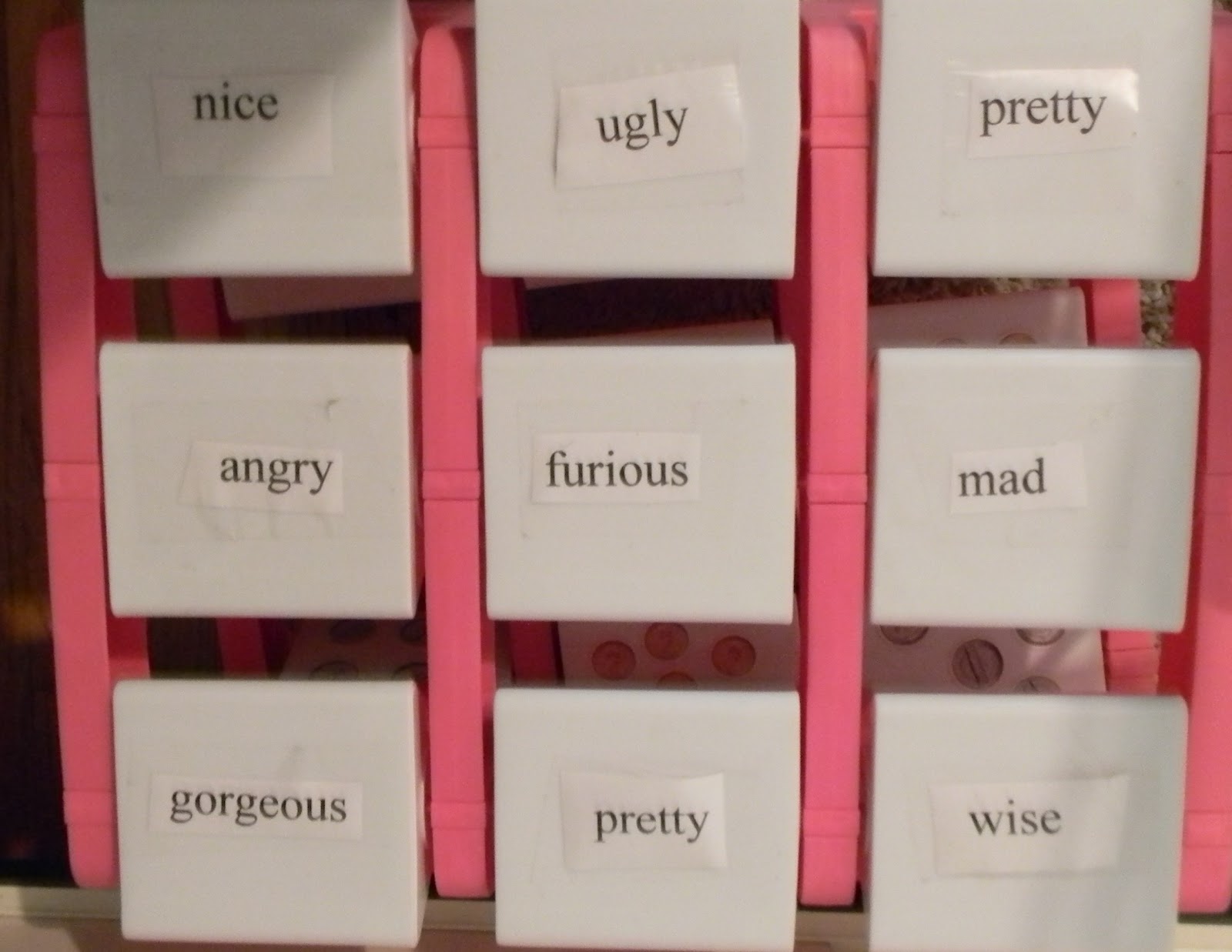
Remember Toss Across?! I found these at TJ Maxx several years ago and new I could make them into a station (probably the only person in the world who goes to the games section 1st at that store-but they often have some good deals). The kids throw the bean bags and try to find 3 in a row-the top one is money amounts and the bottom one is synonyms.
Candyland-this one is for consonant blends, but I've also done vowel sounds. I just put magazine pics on the cards and write the letters in the empty spaces.
Picnic words-our housekeeping food matched to paper plates with that word on it.

Connect Four-alphabet stickers (from the dollar store) on the checkers-took me about 5 minutes to make this game. The students make words horizontally and vertically-very challenging!
3) Stations should be differentiated. I've tried many different ways to do this; it really depends on the group of kiddos you have. I put 3 different tasks in one station and allow the kids to choose what they want to do or start with the easiest and work their way up. I have also assigned them to one of 3 groups and they know what the "red" group, for example, needs to work on. If it's the alphabet station-the lowest group might be matching lower case/upper case, the middle might be putting the letters in alphabetical order, the highest might be putting words in alphabetical order.

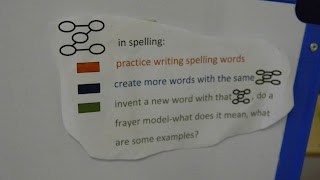
Different options for the different groups in spelling using our patterns icon.
Sunday, June 3, 2012
Outdoor Workstations
I'm reading this book:


It's a little slow in parts, but I love the premise. That our children just don't experience the outdoors the way kids did in the past. Today they don't want to stray very far from their electrical outlets, plus parents are much more overprotective. I feel very blessed to have grown up out in the country (I'm originally from Pennsylvania-or as my kids spell it Pencil-vania :). I went away to week-long Girl Scout Camp every summer for 3 summers-true camping-no electricity, I still remember Polar Bearing in the lake. We learned to build a fire, kayak--that was over 20 years ago and it's still a very vivid memory. Not sure I could win a round of Survivor, but could definitely fend for myself on a camping excursion. Even in our backyard, we used to find many ways to entertain ourselves-chasing fireflies or playing flashlight tag.
Today I'm not sure our kids are getting the same experiences. Many are involved in after-school activities so they don't get home until 5:00-6:00 at night. If it's already dark out parents are rightfully reluctant to let them go play outside. I poll my students often to find out what they are doing on the weekends-9 times out of 10 it's video games or cartoons. Just not intellectually stimulating activities.
So my plan next year is to bring the outdoors into our curriculum! One day per week we are going to take our workstations outside. Here are some of the ideas I've been kicking around, we don't have a lot of space on our playground, but maybe could set up in the large grassy area we have available :
1) Jump rope-making rhyme chants for language arts or counting in math.
2) Magnifying glasses and a clipboard-sounds very simple I know, but my kiddos could entertain themselves very easily with those 2 items. Just let them explore the flowers/insects they find around the building and record what they find.
3) Dirt/rocks in our sand/water table-I am very reluctant to do this indoors because we do have a new school building and are trying to keep everything still looking as new as possible. But they could build a castle with the rocks, think like a scientist and write about the differences, properties of soil, etc.
4) Hopscotch-kids today don't even know what this is! Great way to help coordination skills. I've even done sight word hopscotch or you could do it with math facts.
5) Follow a map to find a treasure-great way to practice real-world map reading skills!
6) Paint with water-no clean up necessary. They could paint letters/numbers/words.
7) Lie on your back and look for shapes in the clouds. They could even write a poem about their cloud or just share it with a buddy.
8) Read a book outside-my puppy loves to just sit and watch the world go by so I do this almost every evening. It just makes it so much more enjoyable (even with the mosquitoes).
9) Yoga station-a few mats and the kids can learn to follow the pictorial or when they start reading, simple word instructions to do the poses.
10) Give them some equipment-Frisbee, hula hoop, various balls and let them invent their own game! Love to see what they come up with. My favorite recess game to watch is "Zombies"-hey, if there is an apocalypse in December, these kids will be prepared!
** Anyone ever done outdoor stations before or have any other ideas, I'd love to hear your suggestions.
Subscribe to:
Posts
(
Atom
)